The Hard Way, Chosen - Character Under Constraints and Silence
Character is vindicated by the deliberate choice of the hard (constructive) and unseen path.
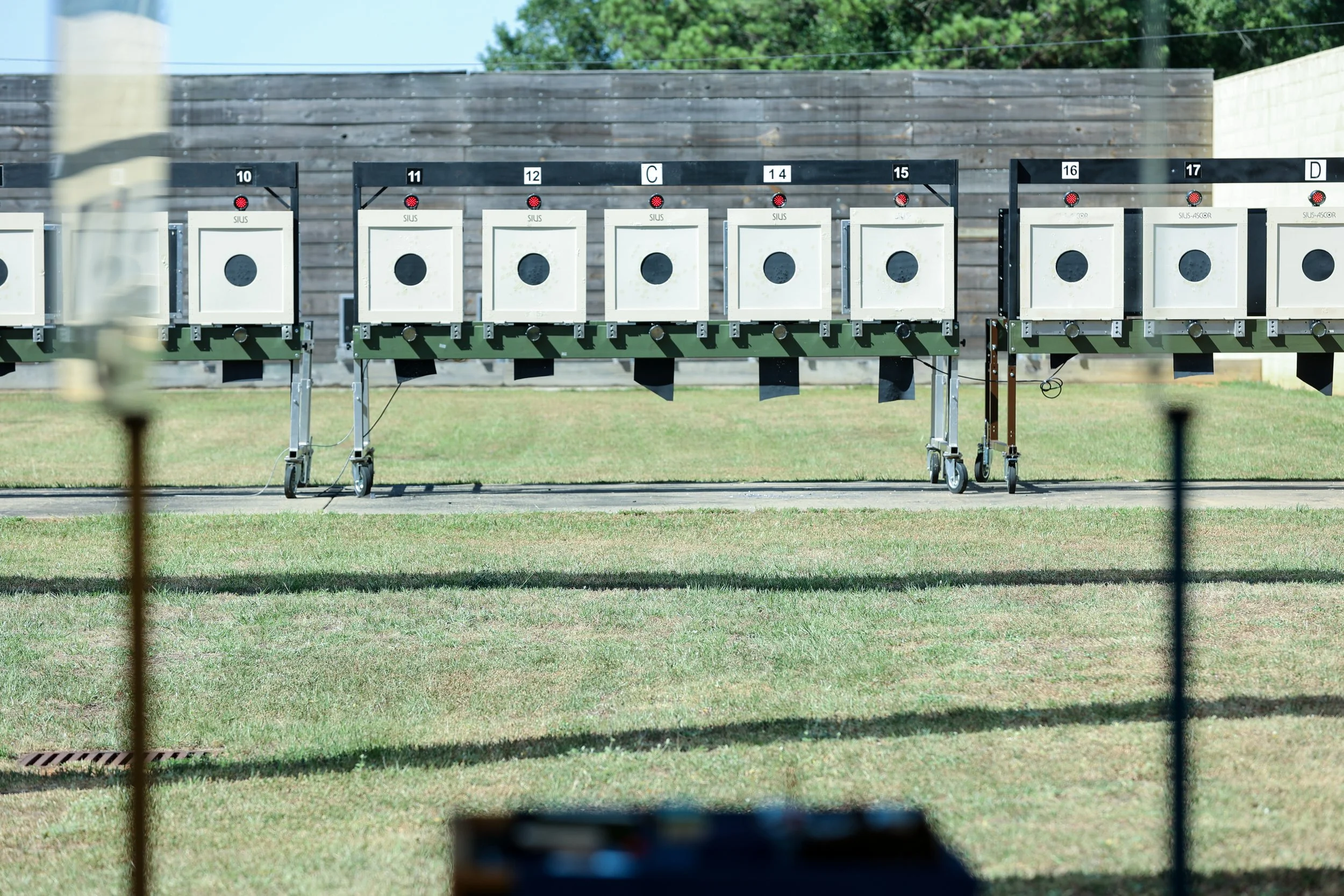
Fort Benning 25m & 50m Finals Range
Introduction: The Order That Governs
The scoreboard does not tell the truth about life in sport. It records only what happened on a particular day under particular conditions. It is silent about the person who arrived, the standards that were kept, the constraints that were negotiated, and the reasons the work continued when the result was disappointing. My athletic philosophy begins with the explicit rejection of the scoreboard’s order of importance. The governing hierarchy is Person, then Sweat, then Accomplishments, then Athlete, then Titles. Everything else in the philosophy is an attempt to live consistently inside that order.
The hard (and constructive) way is always preferred. Sports are meaningless in any materialistic sense. They consist of reaching an arbitrary goal under an arbitrary set of rules that human beings have made up under an ideal setting. What makes them meaningful is the morals that our fellow human beings admire which are shone while reaching those goals—grit, sweat, strategy, integrity under pressure, the willingness to do the unglamorous work, etc. The more difficult the path, and especially the more implicitly difficult (the work that nobody sees), the more character is built and the more meaningful the effort becomes for oneself. Therefore, at the center of the order is a single conviction: every obstacle and every difficulty is a chance to vindicate one’s own morals and character. The easy way is less preferred, because without challenge, no character can be tested and no value is associated with the outcome. And this certainly applies to life in general as well, sports are the epitome condensed of life’s trials.
The Person comes first because the Athlete is a role and the Title is a temporary verdict. Roles can be entered and left. Verdicts in the short run can be revised by the next competition. Neither can be allowed to define the human being who trains and competes. When the order is inverted—when the Title is treated as the measure of the person—sport becomes a machine that consumes the one who practices it. When the order is held, sport becomes a practice through which the person is defined and refined under pressure. Self-knowledge is the necessary starting point of that refinement. It requires a candid and accurate assessment of constraints that cannot be trained away, of capacities that can be built, and mostly, of the difference between the two. If the assessed total of constraints is greater than the total of capacities, not doing it is usually the logical thing to do, if the total of constraints is equal to or less than the total of capacities, then do it (constraints < capacities = do, vice versa). It also requires an honest inventory of the external conditions under which the work is done, and a deliberate choice to treat those conditions as the material of character rather than as excuses in the reduction of standard. However, there are times when the total of assessed capacities is less than the total of real capacities which is brought forth by conviction and hard work—that’s when we cheer for the protagonist.
The Constraints
· Permanent Constraints
I have a severe double-joint condition. The practical consequence for pistol shooting is binary and unforgiving. If I do not fully extend the arm, the elbow cannot be locked. An unlocked elbow is unstable; trying to execute the most precise sport when micromillimeters count, without extending and locking the arm, plus under the recoil and the time pressure of a match is the equivalent of trying to sprint on stilts. Stability requires the lock. Yet if the arm is fully extended and the elbow is locked, the geometry of the double-joint takes the sights out of the visual field. Shooting without seeing the sights is the equivalent of trying to hit a baseball while blindfolded. Every shot is therefore a live negotiation between two requirements that cannot be satisfied simultaneously.[i]
[i] Comparison: severe double-joint arm (L.) vs. straight arm extension (R.). – Paris 2024 Sport Pistol Final.
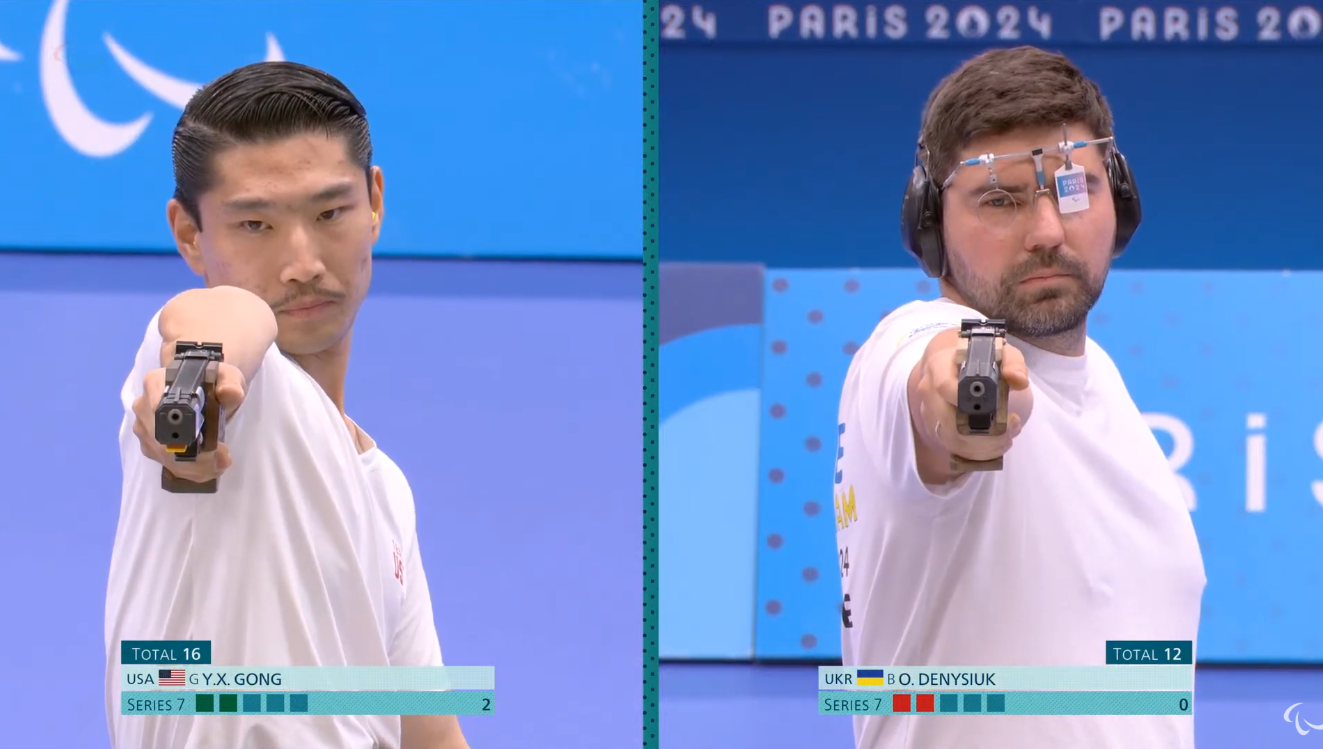
YanXiao Gong and Oleksii Denysiuk (most decorated pistol shooter of Ukraine)
This is not a technical flaw that additional volume will erase. It is a hard physical constraint. When I first entered the sport, the national coaches of both pistol and rifle recognized the problem immediately and preferred that I shoot rifle. I began as a rifle shooter. The preference was rational. And as any qualified athlete would be, logical reasoning was overpowered by the impulse for pistol. After a period of demonstration that the interest was serious and sustained, they acquiesced the switch. The constraint remained. What changed was the necessity of treating the constraint as given and building every adjacent capacity until the deficit no longer decided the outcome, or in my case, became within an acceptable threshold.
Spinal cord injury, constant spasms, right-dominant hand with left-dominant eye, etc., are all examples of Permanent Constraints.
· Non-Permanent Constraints
Although much more impactful and severe the Permanent Constraints usually may be for the person in the long run, most constraints that make the path difficult are non-permanent. These non-permanent constraints can, in principle, change—through different national policy, different funding priorities, different personal circumstances, or different choices. In practice they have been stable for long periods, and they have shaped the daily reality of training and competing as a U.S. Paralympic pistol shooter. One of the clearest examples is body composition.
An overweight body cannot shoot energy-efficiently at the elite level. Excess weight produces brain fog that dulls the fine attentional control the sport requires (especially so for Rapid Fire which the accuracy is down to 1/100th of a second). It makes Rapid Fire swings sluggish; the pistol does not move cleanly, and the recovery between shots lengthens. It also reduces physical tolerance for the extended training blocks that high-level pistol demands, and worse, increases attentional tolerance for poorer executions. These effects are not permanent features of the person. They are the product of a temporary physical state that can be altered.
In the year I joined Team USA and became a resident athlete, I treated that state as a constraint to be removed rather than as a fixed condition. Within less than six months my weight dropped from 185 pounds to 128 pounds. The change was deliberate and intense (perhaps overdone), driven by the recognition that the body had to be made compatible with the demands of elite pistol before the permanent constraint of the double-joint could be managed at the high standard. Once the weight came off, the secondary effects reversed. Brain fog disappeared. Rapid Fire swings became clean and economical. Daily routines gained clarity. The capacity for extended training blocks increased. The attentional tolerance for poorer executions such as fuzzy sight picture and prolonged approaches has become significantly more pronounced and easily identifiable. What had been a continuous drag on attention, movement, and endurance became available capacity.
The episode illustrates the practical difference between Permanent and Non-Permanent Constraints. The double-joint geometry remains. Body weight, by contrast, could be changed. Changing it did not remove the Permanent Constraint, but it removed a considerable layer of friction that had been compounding it. The same logic applies to the other Permanent and Non-Permanent Constraints of the sport. Financial cost, institutional hardships, the absence of NCAA support for pistol, the thin sponsorship market, and the cultural preference in the United States for other forms of shooting are all real. They raise the amount of unseen work required. They are not, however, written into the body or into the rules of the sport in the same way the double joint is, whether internal or external. Some may shift, until they do, they function as additional material on which the standard of the process is tested. The decision to address a changeable constraint remains a choice about how much friction one is willing to remove so that the Permanent Constraints can be compensated to the highest available degree.
The capacities that had to be built are not mysterious. They are the ordinary skills of elite-level shooting—fire control, consistent muscle memory under fatigue, positional repeatability, trigger management, and the ability to treat an imperfect mechanical platform as normal rather than as an excuse. Excellence, under these conditions, is not the removal of the constraint. It is the expansion of every neighboring skill to a standard high enough that the constraint becomes one (and hopefully less of a) variable among others rather than the decisive variable. The person who understands this distinction does not waste energy on the fantasy of a different body. The person invests energy in the skills that remain available. The constraint itself is not an obstacle to be resented; it is the material on which willingness is tested. Choosing the harder path of pistol over the more mechanically sound path of rifle was the first deliberate selection of the hard way. Every subsequent session in which the negotiation between lock and sight picture is solved again is another vindication of the decision to remain with the harder discipline.
The External Conditions of Conviction
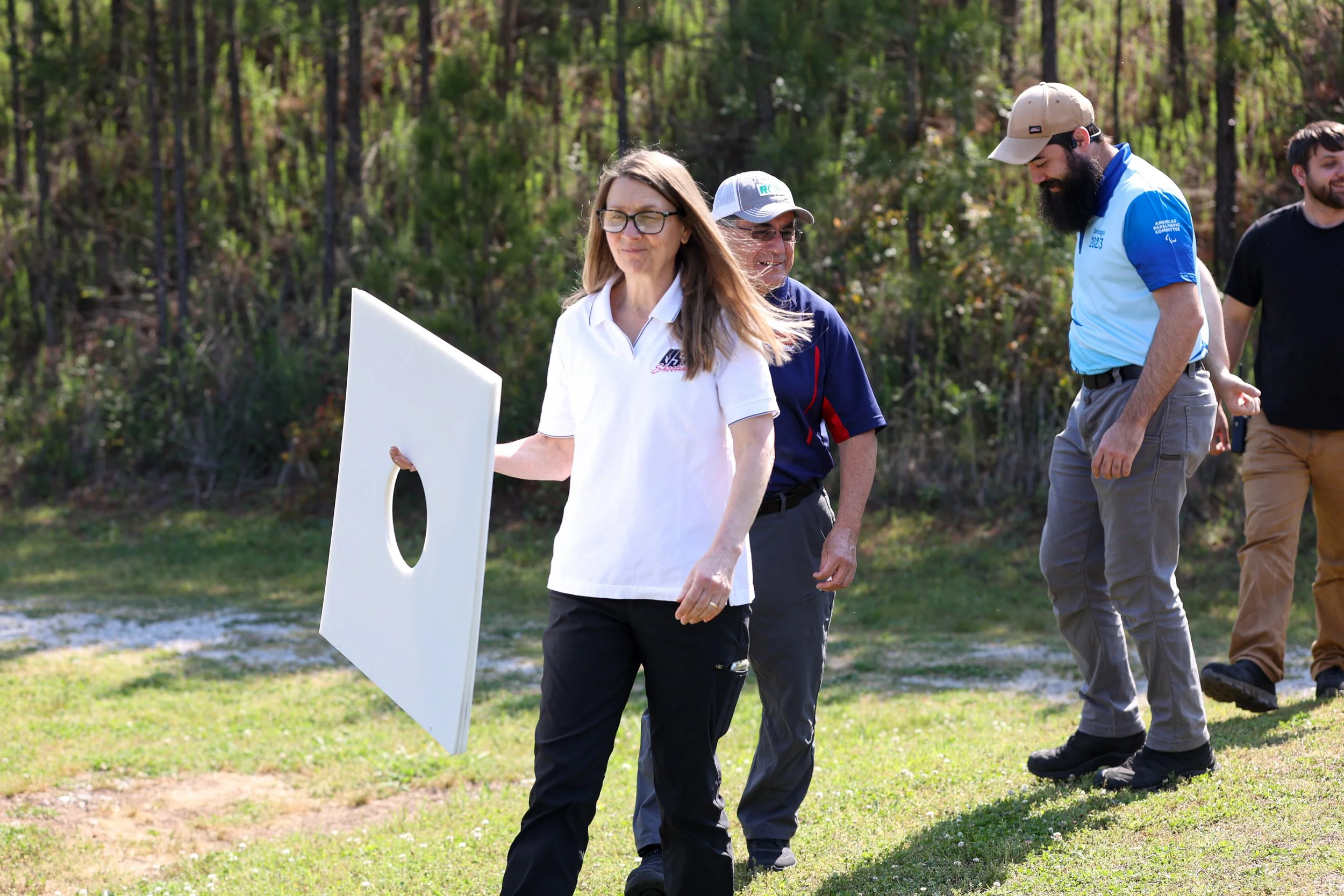
Lisa, Ron, and Nathan of USA Shooting servicing targets
The physical constraint is not the only (Semi-) Permanent Condition. External conditions of the sport itself, especially in the United States, impose another set of requirements that cannot be trained away. Globally, the Olympic and Paralympic Games are the most prestigious level of sport and the place where the greatest resources and status are concentrated. In just about the rest of the world, Olympic and Paralympic athletes are among the most glamorous and best-supported public figures. Unlike most of the rest of the world, the United States does not provide government funding to its National Olympic and Paralympic Committee. The USOPC is a nonprofit that relies on broadcast rights, sponsorships, and donations. This makes the U.S. unusual among sporting nations. In the American sports hierarchy, they sit at the bottom, astronomically distant from the resources and attention given to NFL, NBA, MLB, MLS, etc. There is no meaningful pay. What exists is a small stipend of a few thousand USD a year, and even that is not guaranteed nor consistent. Remaining an Olympic or Paralympic athlete in the United States therefore requires a degree of conviction that is unnecessary in most other national and international systems.
“One of the grand fallacies of our time is that something beneficial should be subsidized.” – Thomas Sowell
Within Olympic and Paralympic sport, shooting is one of the most underfunded. The nature of the stillness of the sport generates little spectator excitement and therefore attracts few sponsors. It is a niche and small market; very few companies invest in designing and manufacturing equipment dedicated to Olympic and Paralympic shooting. In the United States the situation is further complicated by the existence of many other forms of shooting—recreational, practical, hunting, etc.—that draw participants away from the Olympic and Paralympic disciplines. In most of the rest of the world, Olympic or Paralympic shooting is the primary form of organized shooting. Here it competes with far more accessible and less demanding alternatives. Olympic and Paralympic shooting is also among the most expensive sports—ammunition, range build codes and specifications, range access, Olympic and Paralympic level target scoring systems, environmental codes and specifications (lead and air) and their respective solutions, etc., impose high costs that are not offset by sponsorship or prize money.
The difference in tangible reward makes the contrast concrete. A gold medal won by Chao Yang, at the Paris 2024 Paralympics for China was awarded some three million yuan—nearly half a million U.S. dollars. For my silver medal in Paris, the United States awarded $22,500. The gap is symbolic and practical. It reflects two different systems and judgments. Yet, there is something intrinsically and significantly noble in the fact that American medals contain not a dime of their taxpayers’ money. And the phenomenon that by and large, people singularly prefer one way of life over another despite the significant imbalance in pure financial regard highlights some of the highest standing virtues in sports.
Political and institutional factors compound the problem. Shooting is associated with firearms. Political sensitivities have produced a reluctance to promote the sport Both domestically (chiefly) and within the International Olympic and Paralympic Committee, the IOC and the USOPC do not treat shooting as a priority; it is often handled as a stepchild among the Olympic and Paralympic disciplines. Unlike most of the rest of the world, a political factor in firearms exists within the United States, and more so with handguns. In most other countries the notion of a fraught relationship between politics and firearms is simply not understood. Coaches and athletes from places such as China, Russia, S. Korea, for example, repeatedly ask the same question: why does your country not prioritize Olympic and Paralympic shooting? Is it not, after all, a matter of national interest? They have a hard time understanding the political overlay that shapes American support for the sport, as opposed to orders sent from some central planning bureau to fund over a phone call. I call it “the noble disadvantage” in American sports.
Within American shooting specifically, shotgun receives the most resources, funding, and recognition, then rifle, then pistol. Pistol is not NCAA-sanctioned, removing an entire layer of collegiate incentive and support that rifle enjoys. Funding and resources follow a clear hierarchy: shooting receives less than most other sports; Paralympic sports receive less than Olympic sports; and within Paralympic shooting, pistol receives the least. And the American Paralympic pistol shooting sport therefore, occupies the final position in a long chain of constrained resources, visibility, institutional support, and reduced external incentive.
These conditions are not temporary. They are structural. Shooting is a small sport. Pistol shooting is smaller. Paralympic pistol is smaller still. Paralympic pistol in United States is the smallest of all. Both remaining in it, and remaining in it at a high standard, objectively requires the absolute most conviction of any athletic path available in the world. The conviction cannot be borrowed from external reward. It must be generated and sustained by the person who has ordered life according to the hierarchy rather than according to the reward structure of the surrounding sports system.
From the center of the philosophy, these structural conditions are not reasons to leave. They are reasons to stay. They are the most complete available test of character precisely because they offer almost nothing in return. The quiet and unglamorous work of American Paralympic pistol—the unpaid range time, the absence of spectators, the lack of institutional recognition, the continuous negotiation with a body that does not cooperate—is invisible to nearly everyone. That invisibility is what makes it valuable. Character that is displayed only when others are watching is fine, but incomplete. Character that is formed and maintained in the work that nobody sees is the kind that can be trusted when the lights are off. Choosing this path is therefore the deliberate selection of the hardest (and must also be constructive) available conditions under which convictions and morals can be tested.
Shooting – The Most Mental Sport
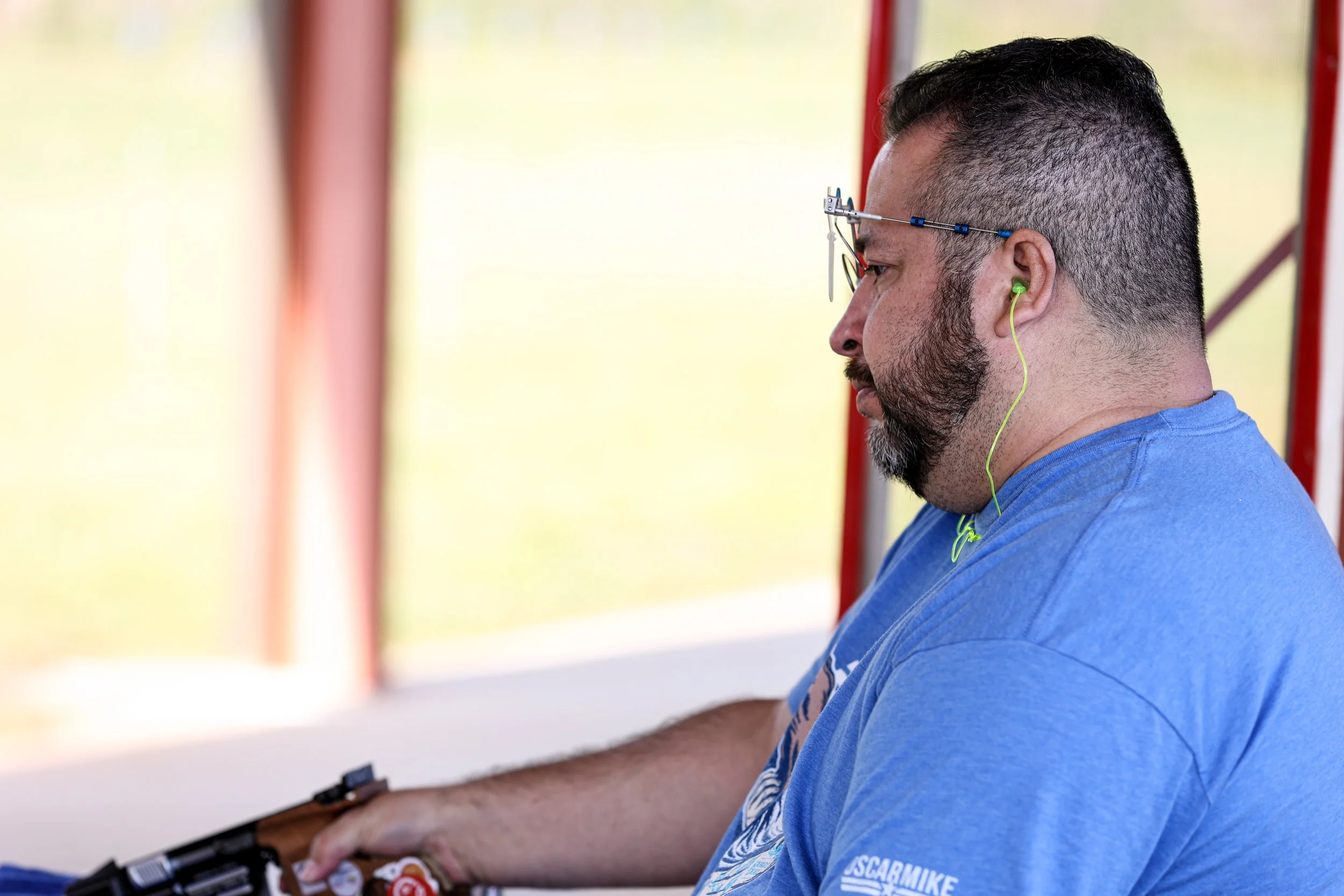
U.S. Paralympic pistol shooter Marco De La Rosa
Shooting is, objectively, the most mental of sports. It requires the most precise control of the body under conditions in which the margin of error is measured in fractions of a degree and 1/100th of a second. The mind does not merely accompany the body. It must govern the smallest motor units while remaining relatively free of the distractions that would enlarge those units into error. In most sports the body supplies a relatively stable platform, and the mind manages tactics, tempo, and decision. In pistol the platform itself is the object of continuous mental governance. When that platform is compromised by various types of constraint, and when the external conditions of the sport supply almost no external reinforcement, the mental demand increases.
The practical implication is that the mental platform must be held to a higher standard than the sport’s ordinary requirements. The negotiation between elbow lock and sight picture cannot be allowed to occupy conscious attention during the shot. It must be addressed in advance, embedded in habit, and treated as background noise. Only then is attention free for the higher tasks of hold, trigger, follow-through, etc. This is not an abstract ideal of mental toughness. It is a technical necessity created by the constraint and by the absence of external reward. Virtue, in this setting, is the daily and largely unglamorous work of attention under conditions that do not reward carelessness and that supply almost no compensatory status or income. The athlete who can perform that work consistently gains a decisive advantage over the athlete who cannot, even when the second athlete possesses a more favorable physical platform or a more supportive national system. The advantage is real, but it is secondary. The primary value of the work is that it is hard and largely unseen. Each session in which the standard is kept is another piece supplied to the picture of a complete and healthy Person.
Process as the Measure
Score is not an end. It is a byproduct of a process. The process can be evaluated independently of the byproduct. Tokyo left me ninth and tenth. Paris left me two points short of gold—the highest achieved and the first American Paralympic pistol medal in 40 years. On paper these are different results. One was a miss caused by a crossfire; one was a historical achievement. Both are facts. Both are information. The approach to both was the same. The volume and intensity of daily work were almost identical. The technical standards were the same. The attitude and the energy invested were nearly the same. Those standards were held at the highest level a human permits.
If the outcome alone had been allowed to determine whether the purpose was complete, the career would have ended after one of the first competitions. The hierarchy prevents that collapse. Accomplishments sit below Sweat. Titles sit at the bottom. The process—the person showing up, the sweat invested at the highest available standard—remains intact regardless of the scoreboard’s verdict and regardless of the near-total absence of external reward. The two results are therefore not hard evidence that the process was good on one occasion and deficient on the other, one might argue one may be an indication, but it is not evidence. They are evidence that the same process produces variable results under variable conditions, and that the process itself is the proper object of evaluation and improvement.
This distinction is especially important for the athlete whose physical platform is not ideal and whose sport supplies little to no external reinforcement. The athlete cannot control the platform’s starting condition or the support hierarchy of the national system. The athlete can control whether the process applied to that platform is held at the highest standard. When the process is the measure, a disappointing result does not directly indict the person or the work. It supplies information. The information can be used to refine the process. It cannot be used to erase the value or the deficiency of the process that has already been performed. The value was never in the result. The value was in the morals shown while reaching an arbitrary goal under arbitrary rules, under conditions that made the showing of those morals unusually costly.
The Cost of Inverting the Hierarchy
There are hard times. The largest and longest came after Tokyo and lasted roughly two years. My grandfather was dying in the months leading into Tokyo 2020 (in 2021) and during the Games themselves. I carried the mental pressure of wanting to justify two years away from him with a medal. That pressure, among other factors (which were major too), harmed the competition. The loss of the person I grew up with, combined with the fact of returning empty-handed from two years of preparation, produced a disappointment large enough that I attempted to outwork it. At one point I was training 14 hours a day, 7 days a week, had to coax security at the Olympic Training Center like Oskar Schindler wooed the German guards to overlook the off-hours I was still on the range.
The effort was real. But it was also a misordering under that circumstance. I had allowed the absence of a title to define the completeness of the Person and the validity of the Sweat. Among other things, the hierarchy had been inverted under the weight of grief, the desire for justification. Recovery required returning to the original order: the Person remained intact even without the medal; the Sweat retained its value even when the result was empty; the next period of work did not require the previous scoreboard’s permission. The two-year ebb is therefore not merely a story of failure. It is evidence of what happens when the hierarchy is abandoned and of what is required to restore it—especially when the surrounding system supplies almost no external reason to continue. The desire for a medal alone to justify the time away was an attempt to make the sport meaningful in a purely materialistic way. The restoration of the hierarchy was the recognition that the sport had already been meaningful in the only way that matters: through the morals that were shown, or failed to be shown—under pressure.
The Consolation of Disproportionate Input
“War is a game that is played with a smile. If you can't smile, grin. If you can't grin, keep out of the way till you can.” – W. Churchill (in the trenches with his men in WWI)
For the athlete who is not naturally gifted in the relevant physical dimension, and who competes in a sport that offers almost no external reward, the structure of competition offers a peculiar and practical consolation. Competition counts only the number of successes. It does not keep an input–output ratio ledger. There is no ratio that penalizes the person who must invest more to produce the same result. The absence of that ratio means one can compensate for a deficit of natural talent, physical suitability, or institutional support with a disproportionate volume and quality of input. It feels almost like cheating. It is not. It is the equivalent of being given a task with no limitation on time and funding.
That structure is available only to the person who can still grin. Games are played with a grin. If you can’t grin, keep out of the way till you can. The grin is not denial of the constraint, the loss, or the near-total absence of external reward. It is the recognition that the hierarchy remains available: the person is still intact, the sweat can still be given at the highest standard, and the next session does not require the previous scoreboard’s permission or the national system’s approval. Titles may or may not arrive. External support may remain minimal. The person who has ordered life correctly does not wait on either to decide whether the work is worth doing. The disproportionate input is sustainable only while the defiant grin remains. When the grin disappears, the input becomes punishment rather than practice, and the hierarchy has already been inverted.
From the center of the philosophy, the disproportionate input is not merely a practical consolation. It is the preferred condition. The harder and more unseen the work required to produce a result, the greater the opportunity to vindicate character. The absence of an input–output ratio does not have to be merely a loophole to be exploited for better scores, it is the structural feature that allows the athlete to choose the harder path without the sport itself punishing that choice. The grin is the sign that the choice is still being made freely and voluntarily.
Team Composition
Balance Between Individuality and “The Greater Good”
“A society that puts equality before freedom will get neither. A society that puts freedom before equality will get a higher degree of both.” – Milton Friedman
It is easy, and consoling to celebrate individual sacrifice for the greater good of the team and team spirit, and morally satisfying to criticize the self-serving and limelight-hungry prima donnas. Yet there is a line between genuine team orientation and institutional collectivism. Where is that line drawn and how can it be identified? The latter constantly eulogizes sacrifice for “the greater good” until where individuals become numbers and individualities become optional. At its worst, the result is a team of contented “dwellers”: athletes who constantly speak of athletic aspirations on paper while delivering the bare minimum the institution accepts. Where everybody is happy, and the highest-performing individuals are quietly driven out.
Priority-First Team Composition
The same distinction between relational comfort and competence applies to how teams are assembled. Professional competence and relational quality (personality, trust, cohesion) are separate attributes. Human language maintains separate vocabularies for those because they are not the same thing. There is no necessary correlation: high skill can coexist with poor interpersonal dynamics, and good spirits can coexist with poor skill. The habitual and wishful attitude of treating them as if they must correlate together is either an unexamined habit and not an observed fact, or a deliberate non-confrontational neglect on the unpopular and uncomfortable reality.
It is socially convenient to criticize “self-serving” athletes and praise “self-sacrificing” ones. It is more useful, however, to ask a prior question: What is the team actually trying to maximize—relational comfort, or competitive results? Because the two are independent, they cannot be treated as a single composite score. A team must first decide what it is optimizing for. The priorities of winning and relational comfort sometimes align; they do not always. Actually, the more elite the levels of competitiveness, the less they align[ii]. When they diverge, the team must choose which one is primary. Once that choice is made, composition becomes a straightforward maximization problem like math.
The decision sequence is as follows:
1. Identify the primary priority. State explicitly whether the team’s highest objective is competitive result (wins, medals, championships, statistical output) or internal culture (relational comfort, trust, cohesion, morale, character standards, etc.). Secondary goals can exist, but one must be ranked first.
2. If winning is primary:
Evaluate available combinations of available players, roles, resources, and coaching inputs by the single metric of expected total output—the size of the cake. Include both individual production and the interaction effects of chemistry, but only insofar as those interactions affect the final score. Character, personality, and off-field conduct are relevant only to the extent they measurably raise or lower that score. Select the combination that maximizes expected results.
3. If relational comfort culture is primary: Evaluate available combination by the single metric of expected total output of cultural quality. Skill and performance matter only to the extent they support or undermine the chosen cultural standard. Select the combination that maximizes the chosen cultural criteria, even if it produces a smaller competitive total.
4. Reassess when the priority changes. If new information or a new season alters what the team is willing to optimize for, restart the sequence. Do not retroactively force the two objectives into artificial harmony, it will produce either superficial harmony with reduced performance, or reduced performance dressed in superficial harmony.
Most frictions in team selection arise from refusing to name the priority. Coaches and players often subconsciously insist that culture and competence must be linked at a 1:1 ratio, then discover that the player who best raises the competitive total is not the player who best raises the cultural total. The framework removes the confusion by treating the choice as prior to the calculation. Once the objective function is defined, the arithmetic of composition is ordinary: which mix of individuals and resources produces the largest value on the chosen metric? Name what you are maximizing, then maximize it. Everything else is secondary commentary.
This framework is consistent with the personal hierarchy. The Person remains prior; the process of selection remains a deliberate, visible act of ordering rather than an unexamined assumption that team comfort and competence will automatically produce the same roster. Where the two priorities align, the calculation is straightforward (very rare at more elite levels). Where they do not, the team is forced to acknowledge the trade-off rather than pretend it is not there.
One of the great virtues of the American free market capitalism is that instead of treating society as a zero-sum game—where one’s gain must be another’s loss, it incentivizes those who are willing and capable, who may or may not for the most selfish or self-serving reasons, must produce something valued the society in order to reach his goal. A society, a team, that singularly focuses on the equality of outcome and rewards regardless of individual contributions, will be reduced to nothing but a “team” of dwellers and “feel-gooders” who treat sports as a mere means of lifestyle while speaking of the highest aspirations of tomorrows.
Conclusion: Living the Order
Person > Sweat > Accomplishments > Athlete > Titles
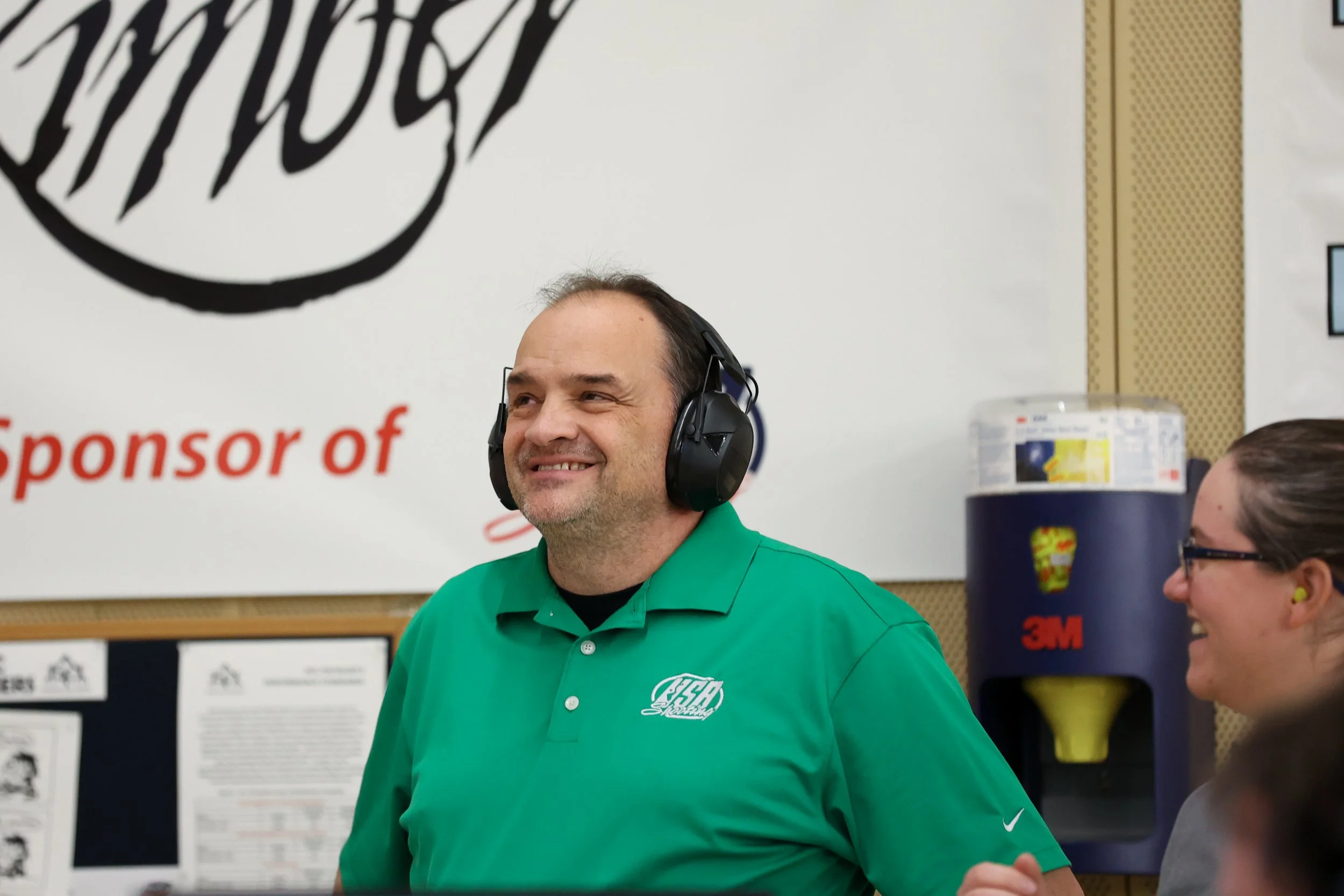
U.S. Olympic & Paralympic coach & USA Shooting Range Director Brent McPherson
The double-joint condition, the mental demands of the sport, and the structural conditions of American Paralympic pistol—minimal funding, limited or absent sponsorship and institutional support, high cost, and negligible external prestige—are permanent. The possibility of disproportionate input is likewise permanent. Results are not. The philosophy that preserves the integrity of the Person is the refusal to invert the hierarchy and the deliberate decision to treat every obstacle as the material of character.
Sports are arbitrary goals under arbitrary rules. They become meaningful through the morals shown in pursuit, especially in the hard, unglamorous work that no one sees. The more constructively difficult the path, the more character is formed and the more the effort matters to the person (and to his God). Excellence is the sustained application of the highest standards to the process, under the candid recognition of limits that cannot be trained away and of external conditions that supply almost no reward, kept by the grin that makes the Person larger than the sport. The easy way is refused, because without the challenge no character can be tested and no value attaches to the outcome. The hard and constructive way is preferred, because only there can the morals that give sport its meaning be fully shown.
Self-knowledge begins with the constraint and the sport’s structural conditions, and continues in the daily choice to treat the process as the proper measure, to keep the Person prior to the role (Athlete), and to refuse both the scoreboard and the system’s silence as definitions of a life. The athlete who can do this does not depend wholly on the titles or the meager stipend to justify the work. The work is already justified by the person who performs it at the highest available standard under conditions that demand the most conviction. That is the order. Everything else is commentary.
Endnotes
[i] Comparison: severe double-joint arm (L.) vs. straight arm extension (R.). – Paris 2024 Sport Pistol Final.
YanXiao Gong and Oleksii Denysiuk (most decorated pistol shooter of Ukraine)
[ii] Athletic excellence follows the same steep curve as the cost of making audio speakers, a speaker delivering ~30% of ideal sound quality may only cost $6 made in a sweatshop; quality of 60% may cost $90; 80% may cost $500; 90% for $1,800; 95% for $6,000; and 98%+ for tens of thousands with only marginal gains; Same in athletic skills, it is easy to improve from 10% to 40%, minimal time and effort input, then each tier becomes exponentially harder. The final stretch from 98% toward 100% becomes nearly prohibitive. “Dwellers” settle at the most economical input-to-output ratio that keeps them barely afloat at institutional standards.
Yan Xiao Gong
U.S. Paralympic Athlete · Team USA · USA Shooting
World Champion
Paralympic Silver
World Cup Champion
Pan-American Champion & 2 Standing Records
Grand Prix Champion & 3 Standing Records
National Champion & 3 Standing Records
Most Decorated American Paralympic Shooter in History
Most Decorated American Pistol Shooter in History